
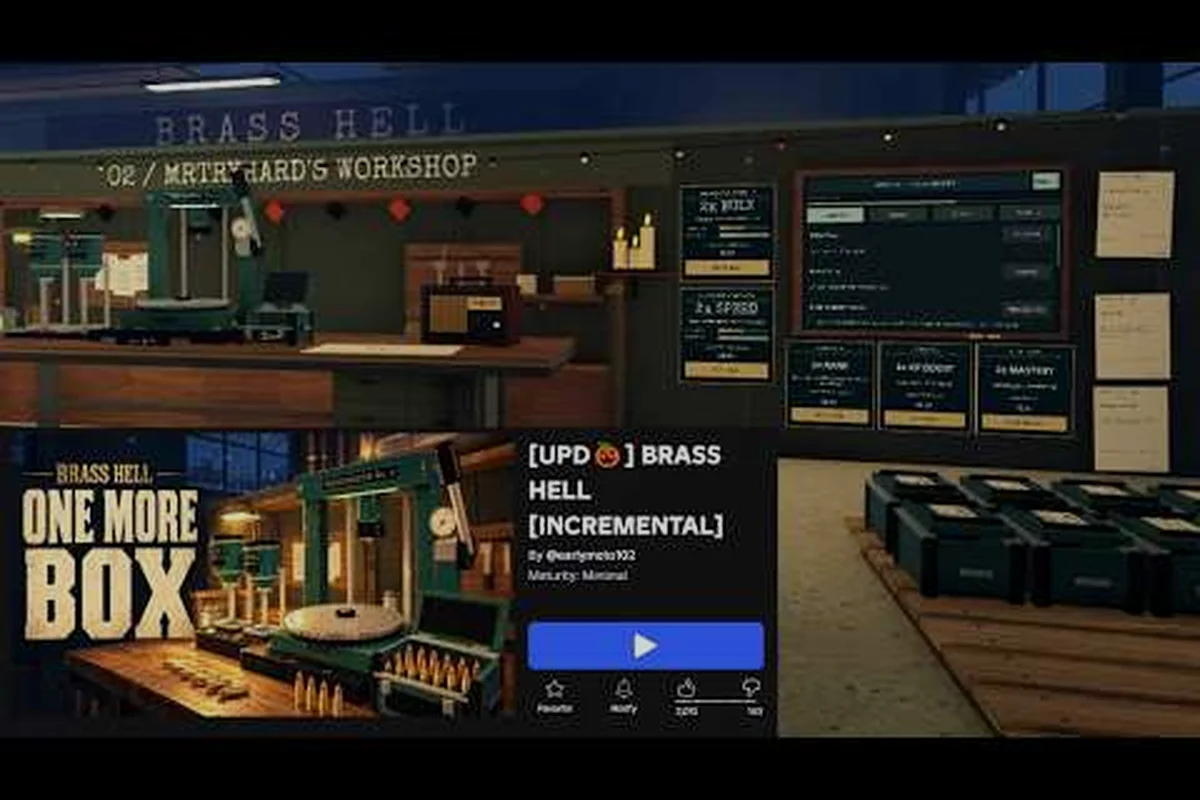
The BRASS HELL update situation is unusual for a game this young: it launched into early access on October 4, 2026, and by Halloween the official page carried a fresh seasonal marker without a single published patch note behind it. If you are trying to work out what actually changed, what is coming next, and whether the BRASS HELL beta is worth your time right now, this breakdown covers the verifiable facts and separates them from community guesswork.
What the Current BRASS HELL Update Actually Contains
The most concrete change on record is cosmetic and seasonal. According to the official BRASS HELL page on Roblox, the October 31 page refresh added a spooky [UPD]🎃 tag to the title. That tag functions as a seasonal and update marker rather than a standalone playable event — there is no separate Halloween mode, no limited-time boss, and no event currency attached to it as of this writing.
That distinction matters because Roblox title tags are often read as event announcements. Here, the tag signals that the developer touched the page, not that new content shipped. The core experience remains the same incremental factory loop that launched on October 4.
| Element | Status as of October 31, 2026 | What It Means for Players |
|---|---|---|
| Title tag | [UPD]🎃 added | Seasonal marker, not a playable event |
| Public changelog | None published | Changes must be inferred from page snapshots |
| Public roadmap | None published | No confirmed feature timeline |
| Game version | Early access build | Systems still subject to change |
| Developer | Solo dev earlymoto102 | Updates arrive at one person's pace |
| Genre listing | Simulation / Incremental Simulator | Expect grind-and-scale progression |
The practical takeaway is simple: if you were waiting for a Halloween content drop, none has been documented. The BRASS HELL update you can actually observe is a metadata change plus whatever silent tuning happened server-side. Note the mismatch between the [UPD]🎃 tag and the table row listing Game version as an early access build with no published changelog — the tag date proves the page was edited, not that the incremental factory loop gained new tiers or prestige layers. Because earlymoto102 develops solo, any balance pass on cash-per-second scaling would land without a patch note, so treat page snapshots as your only audit trail.
Why There Is No BRASS HELL Changelog Yet
Solo-developed Roblox projects frequently skip formal patch notes early on, and this one is no exception. The developer profile for earlymoto102 shows no linked changelog document, no Trello board, and no roadmap post. Community coverage, meanwhile, leans almost entirely on gameplay videos rather than patch analysis, which means update reactions stay anecdotal.
Without a BRASS HELL changelog, the only reliable method is snapshot comparison. Players who screenshot the game page, the thumbnail, and their own save progress before and after a refresh can spot differences that would otherwise go unnoticed. That is tedious, but it is currently the only audit trail that exists.
How the BRASS HELL Development Timeline Has Unfolded
The BRASS HELL development story is short enough to lay out in full. The game appeared on Roblox on October 4, 2026, positioned as an early-access incremental factory simulator. Less than a month later, the page picked up its first visible update marker. Everything else about the schedule is inference.
| Date | Milestone | Verification |
|---|---|---|
| October 4, 2026 | Early access launch on Roblox | Official game page |
| October 4–30, 2026 | Silent tuning, no notes | No published record |
| October 31, 2026 | [UPD]🎃 title tag added | Page snapshot |
| Beyond October 31 | Unannounced | No roadmap exists |
That compressed timeline explains a lot about the current state. A game that is under a month old, built by one person, has not had time to establish a release cadence. Anyone expecting weekly BRASS HELL patch drops is projecting a schedule onto a project that has not published one.
Reading the BRASS HELL Beta Label Correctly
Early access on Roblox is not the same as a closed beta, and the distinction changes how you should approach the game. There is no application process, no invite wave, and no separate test client. The BRASS HELL beta, such as it is, is simply the live build — open to anyone, warts included.
That means balance values can shift without warning, progression curves may be retuned, and a mechanic you build a strategy around today could behave differently next week. Treat every number you read as provisional. For a closer look at how individual patches have been handled so far, the BRASS HELL dev update breakdown tracks the developer-side signals worth watching.
What the Early-Access Factory Loop Plays Like Right Now
Strip away the update question and the game itself is a manual-crafting incremental sim. You build rounds on a press, move crates, and scale output. Community gameplay footage makes the loop concrete: a video from creator Tryhard_Playz titled "How many bullets is too many??" shows players hand-building large quantities of rounds at the press, which matches the game's manual-crafting pitch rather than an automation-first design.
That framing is useful for setting expectations. If you are coming from idle games where the factory runs itself, this one asks for hands-on input first. The Tryhard_PlayzGames channel hosts several runs that show the press-and-crate rhythm before you commit your own session.
| Loop Stage | Player Action | Bottleneck to Watch |
|---|---|---|
| Feed | Load material into the press | Input supply rate |
| Press | Hand-build rounds | Manual click speed |
| Collect | Gather finished output | Inventory space |
| Move | Haul crates | Travel time |
| Scale | Reinvest into capacity | Upgrade cost curve |
Each stage compounds the last, which is why early-session decisions about where to reinvest carry more weight than they appear to. A slow feed rate caps everything downstream no matter how fast you press, since a starved press produces fewer rounds per minute than a well-fed one running at manual click pace. That is why the upgrade cost curve on the Scale row of the loop table deserves attention before you sink currency into raw press speed: raising capacity at the Collect and Move stages widens the pipeline first, so the extra output from a faster press has somewhere to go instead of piling up in inventory space or stalling behind travel time on crate hauls.
Where New Players Usually Stall
The most common early wall is over-investing in press speed before securing input supply. Pressing faster only helps if material keeps arriving; otherwise you spend upgrades on capacity you cannot feed. Community reports consistently point to the feed stage as the real constraint in the first hour.
A second stall point is inventory. Building rounds faster than you can haul them creates a backlog that feels like progress but is actually a queue. Watching a full run before playing helps you see where those queues form, and the BRASS HELL new update overview covers how the build has shifted since launch.
Practical Steps for Tracking BRASS HELL Patch Activity Yourself
Since no official feed exists, you have to build your own monitoring routine. The good news is that it takes about five minutes per check and gives you a far clearer picture than waiting for an announcement that may never come.
-
Screenshot the game page weekly — capture the title, thumbnail, and player count so you can diff them later.
-
Note your own progression numbers — record upgrade costs and output rates; a silent retune shows up as a jump in a value you already logged.
-
Check the developer profile for new creations — a second experience or a group link often signals where attention is going.
-
Watch fresh community uploads — new videos tend to surface mechanics that changed before any text does.
-
Keep a dated log — even a plain note file turns scattered observations into a usable BRASS HELL patch history.
That last point is the one most players skip and the one that pays off most. A dated log converts vague impressions ("the press feels slower") into evidence you can compare against a specific day — for example, noting that on March 14 your first press upgrade cost 1,200 coins at 45 coins/sec output, then seeing the same tier demand 1,500 coins on April 2, tells you a rebalance landed in that window rather than leaving you guessing. Keep each entry to one line: date, stat name, old value, new value, and the source (screenshot, video timestamp, or in-game reading). Three or four weeks of entries builds a genuine BRASS HELL patch history you can cross-reference the moment a BRASS HELL changelog or roadmap finally appears, and it also protects you from misattributing a slow session to a nerf when the real cause was a lag spike or an off-day.
Separating Real Changes from Noise
Roblox games show a lot of surface churn that is not a patch: thumbnail rotations, player-count swings, sponsored placement, and seasonal tags. The [UPD]🎃 marker is a perfect example — visible, dated, and almost certainly not a content drop. Filtering noise means asking whether a change affects what you can do in-game, not just what you can see on the page.
Apply that filter before you touch the changelog: if a change does not alter a mechanic, a value, or an available action, file it as presentation and move on. A reworked weapon skin, a new lobby banner, or a shifted menu icon all fail the test, while anything that moves a damage number, cooldown, enemy spawn rate, or unlock requirement passes it and deserves a line in your BRASS HELL changelog notes. That single rule will save you from chasing phantom updates, and it keeps your BRASS HELL roadmap tracking genuine development instead of cosmetic drift.
What to Expect From the BRASS HELL Roadmap Going Forward
There is no published BRASS HELL roadmap, and pretending otherwise would be misleading. What can be said is structural: a solo developer running an early-access incremental sim typically prioritizes stability and progression tuning before content expansion, because those are the systems players hit first.
| Priority (Inferred) | Likely Signal to Watch | Confidence |
|---|---|---|
| Progression tuning | Silent value changes in upgrade costs | Moderate |
| Stability fixes | Sudden behavior changes in the press loop | Moderate |
| New content | New thumbnails, new mechanics in videos | Low |
| Seasonal events | Title tags beyond [UPD]🎃 | Low |
| Formal changelog | New links on the developer profile | Low |
Treat that table as a set of things to watch, not a promise. The honest answer to "what is next" is that the developer has not said, and the community has not documented enough to fill the gap. The BRASS HELL Halloween event notes dig into whether the seasonal tag has any mechanical follow-through, which is the question most players are actually asking.
How to Judge Whether an Update Is Worth Returning For
Not every change justifies a login. A useful filter is to ask three questions: did the progression curve move, did a new action become available, and did an existing bottleneck get relieved? Two out of three means it is worth a session. One or zero means you can wait.
That filter keeps you from burning time on cosmetic refreshes while still catching the changes that matter. For a structured version of the same approach, the BRASS HELL update guide walks through version-by-version comparison.
Frequently Asked Questions
Is there a real BRASS HELL update on October 31, 2026?
The only verified change is the [UPD]🎃 tag added to the official page title, which functions as a seasonal marker rather than a playable event. No new mode, boss, or event currency has been documented. Treat the tag as a signal that the page was refreshed, not that content shipped.
Why can't I find a BRASS HELL changelog anywhere?
Because none has been published. The solo developer has not linked a changelog, roadmap, or patch notes document from the game page or profile. Update history currently has to be reconstructed by comparing page snapshots over time, which is why dated player logs are so valuable right now.
Is the BRASS HELL beta open to everyone?
Yes. The game is in open early access on Roblox, so there is no invite wave or separate test client. The live build is the beta, which means balance values and progression curves can change without notice. Approach any specific number as provisional rather than fixed.
What should I focus on first in the current build?
Secure your input supply before buying press speed. Pressing faster only helps if material keeps arriving, and community reports consistently identify the feed stage as the first-hour constraint. Inventory capacity is the second wall, since a backlog of unhauled rounds looks like progress but is really a queue.
How often should I check for new BRASS HELL patch activity?
A weekly check is enough for a project this young. Screenshot the game page, log your own upgrade costs and output rates, and skim fresh community uploads. That routine takes about five minutes and will catch silent tuning long before any formal announcement appears.
The BRASS HELL update picture as of Halloween 2026 comes down to a seasonal title tag, an unpublished changelog, and an early-access factory loop that still rewards hands-on pressing over automation. Track your own numbers, filter cosmetic churn from mechanical change, and you will spot the next real shift before the community catches up.